NAM for MPC
C++ · VST2 effect for Akai MPC OS · MIT Source: github.com/jacob-sabella/mpc-vst-nam
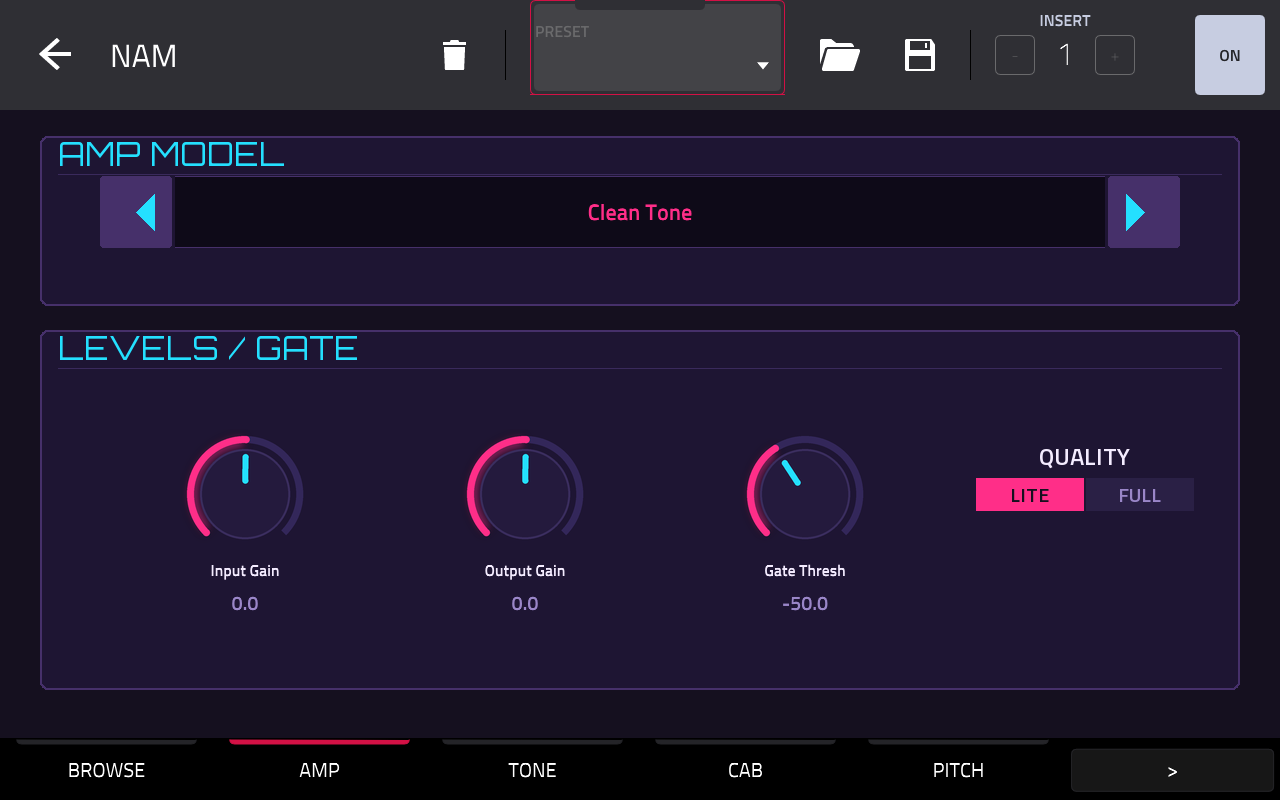
A native VST2 effect plugin for Akai MPC standalone devices. It runs Neural Amp Modeler amp and pedal captures as an insert effect, with a cab IR, tone stack, gate, pitch shift, delay and reverb after the model. It also has a model browser and a TONE3000 tab that downloads new captures straight onto the device. Everything runs on the MPC screen with its own skin and Q-Links.
MPC’s built-in plugin host loads it directly. There’s no companion app or separate GUI process: the plugin serves the TONE3000 sign-in page itself.
Signal path
Stereo in → mono sum → input gain → noise gate → NAM model → tone stack (bass/mid/treble) → cab IR → pitch shift → delay → reverb → output gain → both outputs.
Features
- Engine: vendored NeuralAmpModelerCore. It runs A2 “slimmable” captures at Lite size by default, which is what makes a WaveNet fit on a Cortex-A17 alongside MPC
- BROWSE: every
.namin the models folder, packs shown as folders, ALL / FAVORITES / RECENT filters, and a two-tap delete that moves files to a recycle folder. New files show up within a second without reloading the project - TONE3000: browse Trending / Newest / Most downloaded / your favorites, filter by architecture, quality, gear type and amp maker (mapped to the Q-Links), and download a capture or a whole pack
- PITCH: a single-reader pitch shifter (±24 semitones) that picks splice points by cross-correlation so crossfades stay in phase. No comb filtering, so small shifts don’t sound metallic
- Skin: native MPC screen skin (
TUI.json+ Q-Links) generated from a layout file, with synthwave knob strips
How it works
- Hand-written VST2 effect. No Steinberg SDK: the AEffect ABI is declared in the source
- Parameters are append-only, because MPC stores Q-Link and automation mappings by index. The model and cab are saved by relative path, so a project still finds its model after the library is reorganised
- The TONE3000 client runs on one worker thread, with a tiny HTTP server for the OAuth PKCE sign-in. libcurl is
dlopen‘d, so the plugin still loads on a system without it. Nothing touches the audio thread - Cross-compiled for armhf under Docker (or a bootlin toolchain). CI runs an x86 host build with ABI and audio tests, an offline pitch-shifter test against a two-tap reference, and a TruffleHog secret scan
CPU
Measured on an MPC Key 37 (2× Cortex-A17 @ 1.6 GHz, 44.1 kHz / 128-sample blocks), as % of one core:
| Capture | avg | worst block |
|---|---|---|
| A2 slimmable, Lite (default) | 13% | 17% |
| A2 slimmable, Full | ~85% | — |
| A1 standard WaveNet | 100–200% | — |
Most of the savings come from Lite size plus an inlined GEMM: at these channel counts, Eigen’s general GEMM setup costs more than the math.
Requirements
A first-generation MPC OS standalone device (32-bit ARM) with root SSH access, which means a modded unit. Installing plugins this way is unofficial.